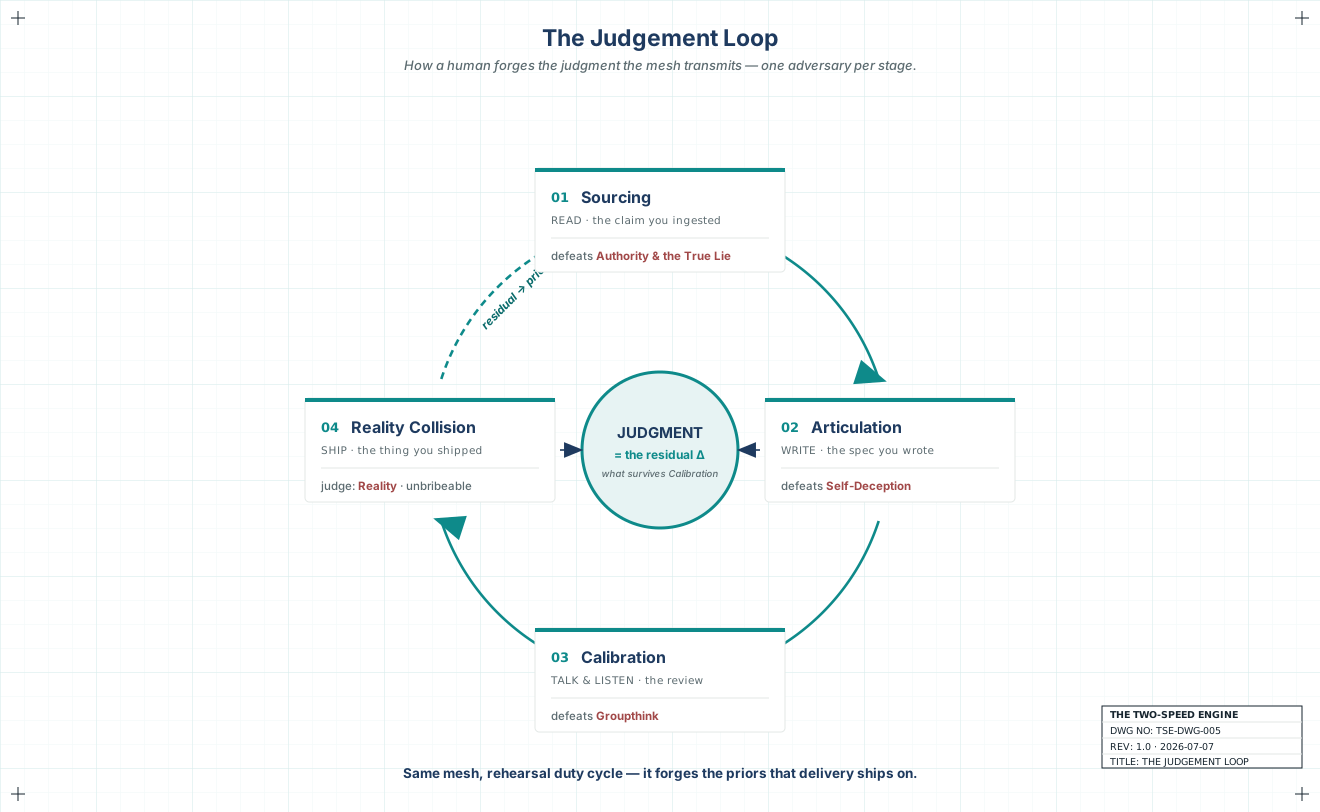
This is not a new framework, and not a second engine. The Two-Speed Engine already names two loops — a human/outer loop that supplies judgment and a machine/inner loop that executes, coupled at the mesh. It treats "human judgment" as an input. This opens that box: the Judgement Loop is the outer loop, up close.
Name the prior art plainly — this is the scientific method (form a claim, test it against reality, update) pointed at your own judgment on a piece of work. The one part that's new is the spine: each stage exists to defeat one specific adversary. Miss the adversary and the stage is theatre.
It isn't a third loop either. It is the mesh running in a different duty cycle: rehearsal — low-stakes, where you forge the priors you'll bring to delivery, where the real work ships. Same coupling of human and machine, two speeds of consequence.
01Sourcing
Observe & Read- The artifact
- What you observed first-hand — or the claim, metric, or doc you ingested
- Adversary defeated
- Omission — theirs & yours
- The filter
- Climb the primacy ladder — observe > testify > aggregate — then run the Question Mark Move: what structural facts must be true for this to hold?
Prefer what you observed first-hand: primary observation has no claimant, so Authority and the True Lie can't touch it — it's the highest-fidelity input and the one people skip. Drive testified inputs up the ladder: can you observe it directly instead? The one enemy is omission, and it hides on both sides of the glass. On testimony, they left it out — Authority leans on the rank of its source, the True Lie is technically true but engineered to mislead, and the Question Mark Move forces the omission open. On observation, you didn't look — selective attention and an unrepresentative sample, beaten by deliberate wide, adversarial sampling: watch the user who churned, not the fan.
02Articulation
Write- The artifact
- The PRD, spec, or design you wrote
- Adversary defeated
- Self-Deception
- The filter
- Not done until it contains a claim reality could prove wrong.
Writing demands definition, and definition exposes the gaps internal dialogue glosses over. A precise-sounding statement that commits to nothing testable hasn't beaten self-deception — only described it more fluently. That falsifiable claim is the prediction Stage 4 tests.
03Calibration
Talk & Listen- The artifact
- The review you ran
- Adversary defeated
- Groupthink
- The filter
- Where's the dissent? Seek the breaking point, not applause.
Instant agreement is gravity, not proof. Stage 3's job is to break everything cheap — in argument — so the surprise that reaches Stage 4 is signal, not noise. It breaks your logic, not yet your outcome.
04Reality Collision
Ship- The artifact
- The thing you shipped
- Adversary defeated
- Reality — unbribeable
- The filter
- What actually broke?
Reality returns unmanipulated feedback — the one judge that can't be swayed by charisma, authority, or desire. It breaks your thesis, not just your argument.
The forge is the residual, not the gap
Judgment is forged in the delta between what you predicted in Articulation and what reality did in Collision — but not the raw gap. It's forged in the residual: the surprise that survived a hard Calibration.
If Stage 3 did its job, cheap error is already gone. What's left is signal — something reality knew that no argument could have predicted. A large residual is high-value judgment. A residual of zero means either you were genuinely calibrated, or Calibration never happened.
That residual rewrites the priors you carry back into Sourcing. That is the loop closing — and it is what makes Calibration a stage inside the loop rather than an optional pre-check.
Not every belief earns a collision
Shipping a real thing to test a belief costs days to months, so a full loop turns slowly. Run Stages 1–3 constantly; reserve Stage 4 for load-bearing beliefs — the ones expensive to be wrong about. Most beliefs should die cheaply in Calibration and never reach reality at all.
When one does earn a collision, log the residual in one line — or it never happened:
Expected: ___ · Got: ___ · Residual surprise: ___ · Prior updated to: ___
No log, no calibration — just a more fluent way of running on intuition.
The machine at every stage
You run the loop using the machine: an adversarial observer & reader in Sourcing, a precision-forcer in Articulation, a devil's advocate in Calibration, a builder in Collision. The machine accelerates every stage. The judgment — the residual, and what you do with it — stays human. That is the mesh, rehearsed.
Monday
- Sourcing — Take one belief your current deck rests on. Before re-reading the report behind it, go observe the reality it summarizes first-hand — one real user, one raw log — and note what the summary left out.
- Articulation — Rewrite your spec's core claim as one sentence reality could falsify. The sentence you can't write cleanly is the flaw.
- Calibration — Hand that spec to the person most likely to attack it. Ask for the strongest objection, not a reaction.
- Reality Collision — Ship the smallest slice that could prove the belief wrong. Log expected versus actual.