Understanding the Agenticverse
Part 1: The Shift to Agency
Understanding the Agenticverse
Part 1: The Shift to Agency
If you spend more than five minutes on tech Twitter these days, you’d think every piece of software is suddenly an “autonomous agent.” The word has become so overloaded that it’s losing its meaning.
But beneath the hype, the shift from conversational LLMs to agentic systems is the most significant architectural change in the product landscape right now. We are moving away from software that waits for instructions to software that executes on intent.
For product managers and builders, understanding this shift isn’t about learning a new programming language; it’s about adopting a completely new mental model for how software interacts with users.

Photo by Google DeepMind on Unsplash
The Agentic Spectrum: Moving Beyond the Chat Box
The industry spends a lot of time debating a binary question: Is this feature an agent, or is it just a wrapper? Does it need to reason about its environment? Does it need to run completely autonomously?
As AI pioneer Andrew Ng has pointed out, it is much more useful for product teams to view the agency spectrum. Systems don’t simply flip a switch from “dumb bot” to “AGI.” Instead, they exhibit degrees of agentic behaviour.
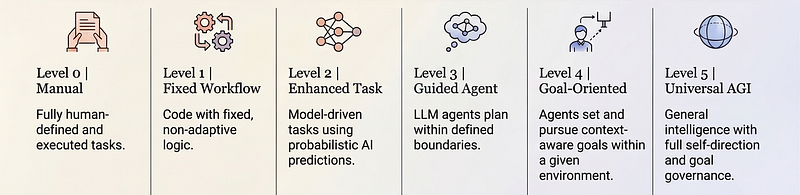
The healthiest mental model for an agent is to think of it as an AI microservice — a specialised application with a specific job and the tools necessary to execute it.
Anatomy of an Agent
To build on this spectrum, every agentic system generally relies on three core components:
- Perception (Context): How the system ingests the state of the world (e.g., reading a live transcript, scanning a GitHub repo, or checking the weather).
- The Brain (LLM/Routing): The reasoning engine. This is where the system takes the perception, applies a “Chain of Thought,” and breaks a complex goal into actionable steps.
- Action (Tools): The hands of the system. The API calls, database queries, and web searches the agent executes actually affect the outside world.
Decoding Intent: The Bridge Between Chat and Action
Before the “Brain” can use its “Hands,” it must solve the hardest problem in modern product design: understanding Intent.
In traditional software, intent is explicit. A user clicks a button that says “Create Ticket,” fills out a rigid form, and clicks “Submit.” The software doesn’t have to guess; the UI forces the user to translate their goal into a machine-readable format.
In the agenticverse, intent is implicit and messy. It is buried in unstructured natural language. Intent extraction is the process by which the agent parses a conversation, a document, or an environment to figure out the actual underlying goal. It is the leap from analysing what was said to determining what needs to be done.
The Product Teardown: Copilots vs. True Agents
To see the agentic spectrum and intent extraction in action, let’s look at a domain currently undergoing massive transformation: meeting orchestration.
Most of the “AI features” we’ve seen bolted onto SaaS products over the last year live on the low end of the agentic spectrum. We call these Copilots.
A standard meeting copilot takes a call transcript and, when prompted, generates a summary or a list of bullet points. It is a useful feature, but it is entirely reactive. The user still has to pull the levers. The perception is static, the brain is only used once, and the action is just returning text. It doesn’t understand intent; it just follows a command.
Now, let’s move up the spectrum and look at a highly agentic platform like Facilitron.
Facilitron operates completely differently. It doesn’t just wait to summarise what happened; it actively orchestrates the outcome by continuously scanning for intent. If someone on the call says, “I’ll look into the API rate limits before Thursday,” the system extracts the underlying intent: Task Creation.
It identifies the specific blocker, determines which team member owns it, and autonomously routes the task — drafting and assigning a Jira ticket with a Thursday deadline — without needing a human to type a single prompt or click a single button. That is the shift to agency. The product is no longer a tool you wield; it is a collaborative partner in the workflow.
Enter Agenticverse
Building these highly autonomous, collaborative systems requires a completely new discipline. When an LLM is taking actions on a user’s behalf — like assigning work to a colleague based on perceived intent — getting it wrong isn’t just a minor hallucination; it’s a broken product experience.
Product teams are no longer just designing visual interfaces and button placements.
You are tuning the system’s hidden interaction loops. How strict should the agent be when deciding if something is an actual task versus a passing comment? How long should it wait to gather context before executing the tool? What is the communication style of the final output? Tuning these behavioural boundaries and latency profiles is how you engineer an agent that feels deeply competent rather than chaotic.