Understanding Coaching and the Coaching Mindset
Putting coaching into practice with “The Coaching Habit by Michael Bungay Stanier”
Understanding Coaching and the Coaching Mindset
Putting coaching into practice with “The Coaching Habit by Michael Bungay Stanier”
The ability to coach and be coached is a game-changer in this emerging world of technology. We are expected to juggle many responsibilities, from defining the vision to collaborating with cross-functional teams. Amidst this complexity, coaching emerges as a crucial skill, enabling us to unlock our team’s potential, foster collaboration, and drive success.
Coaching is not about providing answers or solutions; instead, it’s about asking the right questions to stimulate thought, encourage self-discovery, and promote problem-solving skills. It’s about guiding individuals or teams to realize their full potential and achieve their goals.

Photo by Jamie Street on Unsplash
Adopting a coaching mindset creates an environment where every team member feels valued, heard, and empowered. This can significantly improve team morale, collaboration, and overall performance.
Developing a Coaching Mindset
Developing a coaching mindset requires practice and patience. It involves honing our listening skills, learning to ask powerful questions, and resisting the urge to jump in with solutions. It also requires a genuine interest in helping others succeed.
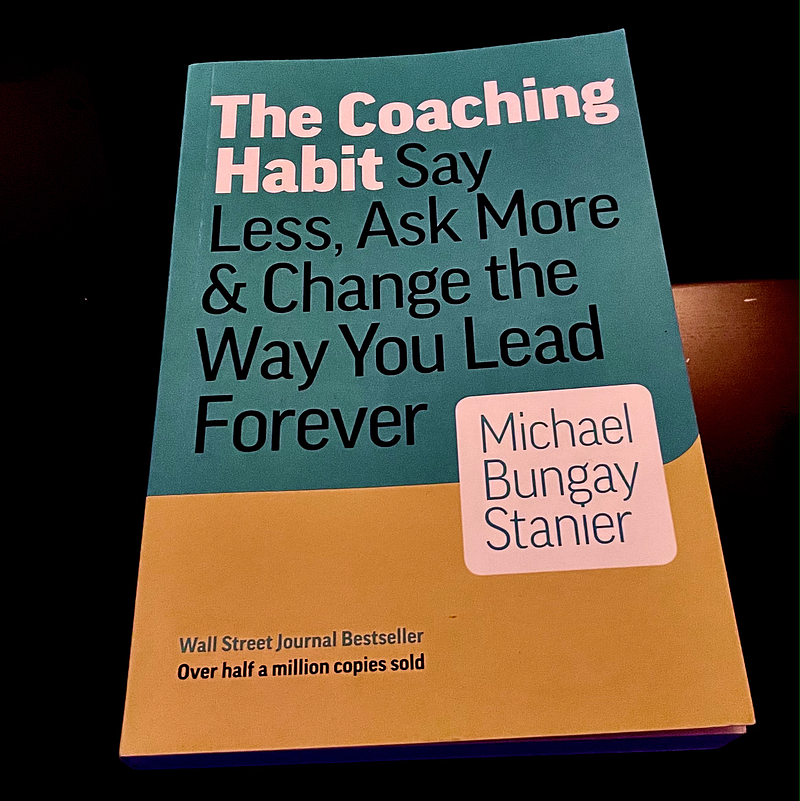
“The Coaching Habit” by Michael Bungay Stanier could be a good start as it provides practical tools and techniques to develop a coaching mindset. The book is structured around three key behaviors, one practical tool, and seven essential questions that form the basis of effective coaching.
Behaviors
To be effective at coaching, Michael suggests developing three key behaviors,
Building a Habit of Curiosity:
We are encouraged to ask questions rather than provide answers, fostering a sense of self-discovery and empowerment in our teams. This behavior helps us resist the urge to jump in and solve problems, allowing our teams to develop problem-solving skills.
Practicing Listening:
Effective coaching requires active listening. We must genuinely hear our team members’ voices to understand their perspectives and provide appropriate guidance. This behavior helps us to build trust and open communication within the team.
Encouraging Reflection and Learning:
It is essential for a coach to promote reflection and learning within the team. We can help our teams learn from their experiences by asking questions that prompt reflection and continuously improve.
Seven core questions that form the basis of effective coaching:
The Kickstart Question:
This question is designed to jumpstart the conversation and cut through the fluff. For instance, a question like, “What’s on your mind?” can open up the dialogue, allowing the individual to share their most pressing thoughts or concerns.
The AWE Question:
Standing for “And What Else?”, this question is meant to deepen the conversation and uncover additional insights. For example, after discussing a team member’s challenge, you might ask, “And what else is challenging about this situation?” to encourage them to explore the issue more deeply.
The Focus Question:
This question helps pinpoint the most critical issue. A question like, “What’s the real challenge here for you?” can help the individual hone in on their problem’s root cause rather than getting lost in secondary issues.
The Foundation Question:
This question seeks to understand what the person truly wants. Asking, “What do you want?” can help clarify their desires or goals, providing a more straightforward path forward.
The Lazy Question:
This question, “How can I help?” encourages the other person to think through the problem and propose solutions, promoting autonomy and problem-solving skills.
The Strategic Question:
This question, such as “If you’re saying ‘yes’ to this, what are you saying ‘no’ to?” helps to understand the broader context and the potential impact of the problem or solution, fostering strategic thinking.
The Learning Question:
This question, “What was most useful for you in this conversation?” encourages reflection and learning from the situation, promoting continuous growth and development.
How to be effective?
The book also includes a masterclass on how to ask these questions effectively,
Ask One Question at a Time:
By asking one question at a time, you allow the other person to fully process and respond to the question, leading to more meaningful and productive conversations. For example, instead of asking, “What challenges are you facing and how are you planning to address them?” break it down into two separate questions: “What challenges are you facing?” and “How are you planning to address them?”.
Cut the Intro and Ask the Question:
Instead of prefacing your questions with lengthy introductions or explanations, get straight to the point. For instance, rather than saying, “I’ve been thinking about our project, and I was wondering…” ask, “What’s the next step for our project?”.
Stick to Questions Starting with “What”:
This suggests that questions starting with “what” is often more open-ended and thought-provoking than “why” questions, which can sometimes sound blame. For example, instead of asking, “Why did you choose that approach?” ask, “What made you choose that approach?”.
Get Comfortable with Silence:
After asking a question, allow the other person time to think and respond. For example, if you ask, “What’s the real challenge here for you?” resist the urge to fill the silence or suggest answers. Give the other person the space to reflect and respond.
Actually, Listen to the Answer:
After asking a question, focus entirely on the other person’s response. Resist the urge to plan your next question or comment. For example, if you ask, “What do you want?” pay close attention to the other person’s answer and respond in a way that shows you’ve honestly heard them.
Acknowledge the Answers You Get:
Acknowledge their answer before moving on after the other person responds to a question. For example, if a team member shares a challenge they’re facing, you might say, “That sounds tough. I appreciate your honesty in sharing this with me.”
Use Every Channel to Ask a Question:
Whether it’s a face-to-face meeting, a phone call, or an email, we can use the same coaching principles to guide our conversations. For example, if a team member sends you an email about a problem they’re facing, you can respond with a coaching question like, “What have you considered so far?”.
Building a coaching habit
To put these learnings into practice, “The Coaching Habit” presents a practical tool for leaders to develop a coaching habit: the habit-building process. This process is based on the understanding that habits are formed through repeated behaviors over time. It involves three key components: a trigger, a behavior, and a reward.
Trigger:
A trigger is a cue that initiates the behavior. It can be a specific time, place, emotional state, other people, or an action that precedes the behavior. For example, a meeting with a team member could trigger a coaching conversation.
Behavior:
The behavior is the action you take in response to the trigger. In the context of the book, the behavior is asking a coaching question. For example, in response to the trigger (the meeting), you might ask the Kickstart Question: “What’s on your mind?”
Reward:
The reward is the benefit you get from the behavior. It reinforces the behavior, making it more likely to be repeated. For example, the reward could be a better understanding of our team member’s thoughts, challenges, or goals.
To build a new habit, we must clearly define these three components. We need to identify a specific trigger, decide on the behavior (in this case, ask a coaching question), and recognize the reward.
It is necessary to understand the importance of repetition in habit formation. The more we repeat behavior in response to the trigger, the more ingrained the habit becomes. Over time, the behavior becomes automatic, and we’ll naturally adopt a coaching approach to managing people.
In addition, focusing on one habit at a time can make the habit-building process more manageable and effective. For example, start by focusing on the habit of asking the Kickstart Question in meetings. Once this habit is established, we can move on to the next habit.
In conclusion, the habit-building process presented in “The Coaching Habit” provides a practical tool for developing a coaching habit. By understanding and applying this process, we can effectively integrate coaching into their everyday leadership style.