The “De-Evolution” of Man?
I saw this image circulating recently (if you’re on LinkedIn, you’ve probably seen a variation of the “De-Evolution” meme). It creates a…
The “De-Evolution” of Man?
I saw this image circulating recently (if you’re on LinkedIn, you’ve probably seen a variation of the “De-Evolution” meme). It creates a linear narrative that suggests humanity loses something fundamental with every major invention. It claims that because we cook, our jaws are weak. Because we use machines, our muscles are weak. And, inevitably, because we use AI, our brains will become weak.
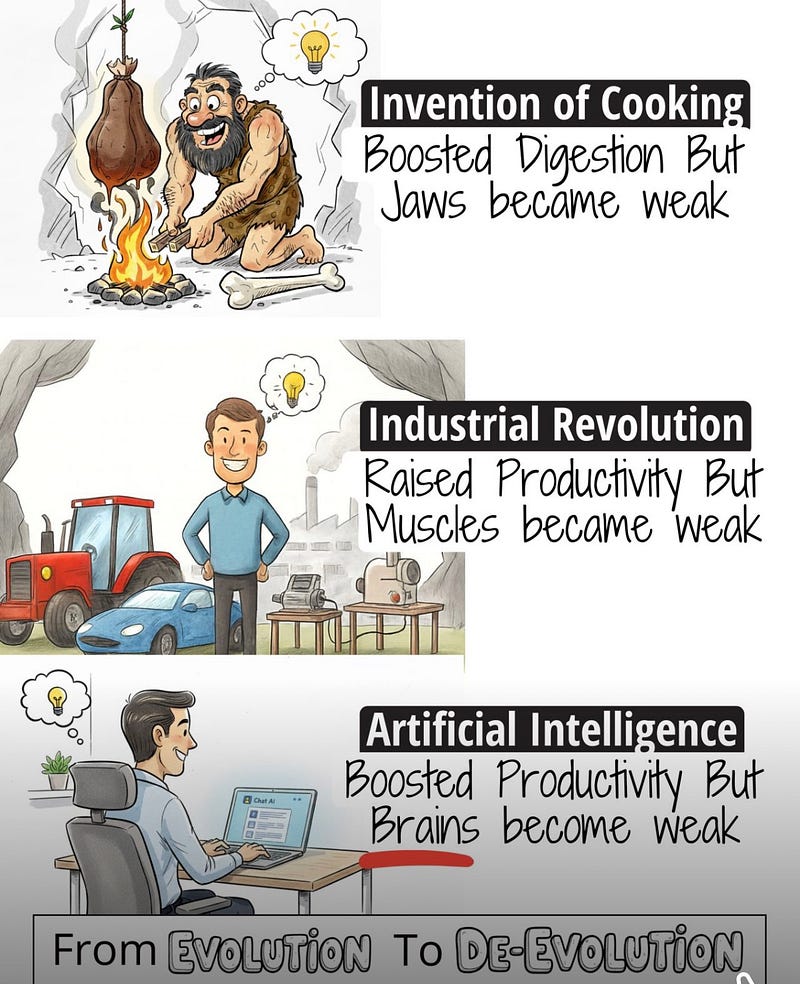
But this view misses the fundamental principle of Resource Reallocation.
We didn’t just lose jaw strength; we gained cortical mass. We didn’t just lose muscle mass; we gained civilisation. We aren’t about to lose our minds to AI; we are about to clear the cache for higher-order thinking.
However, we must learn from history. Progress isn’t passive; it demands proactive adaptation.
From DE-EVOLUTION to CO-EVOLUTION
1. The First Trade-Off: Outsourcing Digestion to Fire.
When early humans harnessed fire and began cooking, it wasn’t about weakening our jaws. It was about an incredible energy hack. Cooking breaks down food, making nutrients more accessible and digestion less energy-intensive.
The Shift: We outsourced complex digestion to an external process.
The Gain:
Energy Reallocated → Brain Size Doubled.
This freed up immense biological resources, fueling the rapid development of our complex brains, leading to language, culture, and innovation.
2. The Second Trade-Off: Outsourcing Muscle to Machines
The Industrial Revolution saw us build machines to lift, carry, and manufacture. We moved from physically demanding agrarian lives to increasingly sedentary roles.
The Shift: We outsourced heavy physical labour to external tools.
The Gain:
Labour Offloaded → Global Connection & Scale.
This ushered in unprecedented productivity, mass production, urbanisation, and a globally interconnected society, creating wealth and raising living standards.
The Unintended Consequence & The Commercialisation of Weakness:
Here’s where the lesson lies. While machines liberated us from physical drudgery, society largely failed to adapt holistically. We stopped moving, but often continued to consume. This societal shift, left unaddressed by conscious design, led to a decline in many people’s physical fitness.
And what emerged? The Fitness Industry. We now pay to go to dedicated spaces (gyms) to simulate the physical exertion our ancestors got for free. This industry effectively commercialised our muscle weakness, selling us back the strength we inadvertently gave away.
3. The Third Trade-Off: Outsourcing Repetitive Cognition to AI.
Now we stand at the precipice of the AI revolution. The meme fears that we’ll surrender our minds, becoming “brain weak.”
The Shift: We are outsourcing repetitive data processing, pattern recognition, and rote tasks to algorithms.
The Gain:
Cognition Amplified → Creative Strategy & Empathy.
AI is poised to free up enormous mental bandwidth, allowing us to focus on uniquely human strengths: critical thinking, ethical reasoning, deep creativity, complex problem-solving, and emotional intelligence.
Preventing “Cognitive Atrophy”: The Call for Proactive Adaptation.
The mistake from the Industrial Revolution was passive acceptance. We can’t afford to repeat it with AI. If we let AI do all our thinking, analysing, and synthesising without active engagement, we risk genuine cognitive atrophy. We can’t be like the industrial-era worker who stopped moving and then wondered why they became weaker.
Cognitive atrophy is the loss of neurons and their connections, leading to a decrease in brain size and impaired cognitive function.
The Path Forward: Co-Evolution, Not De-Evolution.
The solution isn’t to reject AI. It’s to co-evolve. We must consciously design our interaction with AI to augment, not diminish, our capabilities:
- Active Engagement: Use AI as a co-pilot, not an autopilot. Challenge its outputs, ask more profound questions.
- Upskill Human Uniques: Invest in developing critical thinking, creativity, ethical leadership, and emotional intelligence — skills AI cannot replicate.
- “Cognitive Fitness”: Just as we have gyms for our bodies, we need practices for our minds: continuous learning, deep reading, philosophical inquiry, and engaging in complex, abstract thought.
The meme is wrong. We aren’t de-evolving. We are simply trading old challenges for new opportunities. We are clearing the table for the next level of human work and expansion.
The question is: Are you ready to do the new heavy lifting?

Photo by Google DeepMind on Unsplash