Notes from Marketing Master Class from Idea Pattarai
Speaker: Suresh Sambandam, Convenor of Dream Tamilnadu.
Notes from Marketing Master Class from Idea Pattarai
Speaker: Suresh Sambandam, Convenor of Dream Tamilnadu.
Marketing is everything and everything is marketing — Regis McKenna
The basic understanding of marketing starts with knowing that Marketing ≠ Sales. (1)
Marketing
Marketing is all about getting people interested in your company’s products and services whereas sales are specifically about selling those products and services.
Marketing is the process of winning the battle in customers’ minds by communicating a value customers remember with a brand. Eventually leading to that brand becoming the substitute for the category. For example how we say Xerox instead of Photocopy or Google for search etc.
Marketing is not the art of finding clever ways to dispose of what you make. Marketing is the art of creating genuine customer value. It is the art of helping your customer become better off — Philip Kotler
To make marketing work efficiently it should be a leadership function.
Marketing is too important to be left to the marketing department — David Packard
Few common misconceptions about marketing, before we move to the next lesson.
Marketing vs Advertisement
Marketing is the process of identifying customer needs and determining how best to meet those needs. In contrast, advertising is the exercise of promoting a company and its products or services through paid channels. In other words, advertising is a component of marketing.
Marketing vs Branding
Marketing is the process of getting your message out to the customers. Whereas branding is a set of activities for defining and shaping the identity of a business. It answers who you are and what you stand for. While marketing answers the how.
Brand vs Commodity
A commodity is identical no matter who produces it, while a brand refers to a unique good or service that is different from other goods or services in some way.
The art of marketing is the art of brand building. If you are not a brand, you are a commodity. Then the price is everything and the low-cost producer is the only winner — Philip Kotler
Market
The second lesson is to acknowledge the fact that everyone is not your customer. A market is a group of people with common needs and wants, who are referenceable to each other.
Need vs Want
A need is something necessary to live and function. A want is something that can improve your quality of life. For example, a pain killer is a need whereas a vitamin supplement comes under want. A utility can be considered a need and aspirational items fall under want.
Authentic marketing is not the art of selling what you make but knowing what to make. It is the art of identifying and understanding customer needs and creating solutions that deliver satisfaction to the customers, profits to the producers, and benefits for the stakeholders — Philip Kotler
Demand
When a customer is willing and able to buy a need or a want, it means that they have a demand for that need or want.
Creating demand is hard. Filling demand is easier. Don’t create a product, then seek someone to sell it to. Find a market — define your customers — then find or develop a product for them — Tim Ferriss
other common misconceptions in marketing,
Positioning vs Marketing Slogan
Brand positioning statements are created for internal use. These statements guide the marketing and operating decisions of a business. But a marketing slogan is an external statement used in your marketing efforts. Insights from positioning statements can help us define a slogan.
Template:
When you want to compare yourself to a competitor:
For ______________ that need _____________________, _________________ is a _________________ that ___________________________________________. Unlike __________________, our product ______________________________.
When you want to focus on your customers:
For _______________, ___________________ is the ________________ that will _____________________________ so they can____________________________.
Crossing the Chasm
Understanding the product life cycle is very important because the needs of the customers at each stage would be different. This also helps in positioning the product right, picking the right price, and channels for marketing.
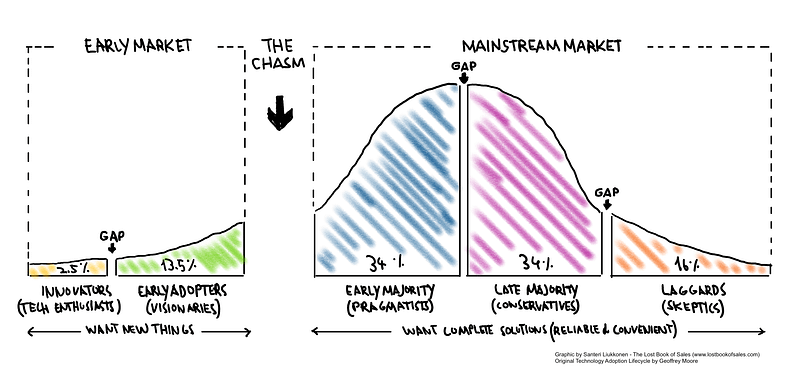
The Bowling Alley
Bowling alley is an strategy when you go to cross the chasm and start to plan out how you will build the whole product, it helps to identify specific market segments in the early majority that you want to target and who will help you specify and create the whole product.
4P’s of Marketing
Product, Place, Price, and Promotion
Laws of Marketing
- Marketing is a battle of perceptions, not products or services.
- It’s better to be first than it is to be better.
- If you can’t be first in a category, set up a new category you can be first in.
- It’s better to be first in the mind than to be first in the marketplace.
- You have to give up something in order to get something.
- For every attribute, there is an opposite, effective attribute.
- Marketing effects take place over an extended period of time.
- Over time, a category will divide and become two or more categories.
- In the long run, every market becomes a two-horse race.

People mentioned:
Books mentioned:
The 22 Immutable Laws Of Marketing
For more information you can visit the organizers website https://ideapattarai.com/