Not just One more thing*
Apple Vision Pro, WWDC23, visionOS
Not just One more thing*
Apple Vision Pro, WWDC23, visionOS
After last year’s disappointment, I watched this year’s WWDC with my fingers crossed. As we saw in the previous year, the new updates on the MacOS, iOS, iPadOS, and WatchOS promised that things are coming together for the spatial computing era. Even this year’s announcement hinted the same, with features on widgets and airdrop all pointing to the spatial world.
Is the apple ecosystem getting ready for the glass?My observations at the WWDC20siddarth.design
And finally, with the “One more thing” announcement, the whole industry was looking forward to another iPhone moment. However, there is a long road to confirm that it will have the same impact as the iPhone in history. But let’s look at why this is a much-needed event for spatial computing.
We might not already realize more applications that fit into the bucket of spatial computing we use daily.
Spatial computing is a field of computer science that deals with the interaction between humans and computers in three-dimensional space.
With headsets like vision pro, we can perceive depth and sense of space. This perceived sense helps us increase immersion in the content and rethink reality.
Ok, let’s understand why this announcement from Apple is exciting for spatial computing. Multiple players have done this before, but this is the first time a company has brought everything together. The hardware, operating system, tools, and frameworks are together for efficient creation and consumption. This announcement could be a game changer, and Apple could lead the industry forward, similar to the mobile computing era. On top of this, Human Interface Guidelines from Apple could set specific standards for how we interact with spatial interfaces.
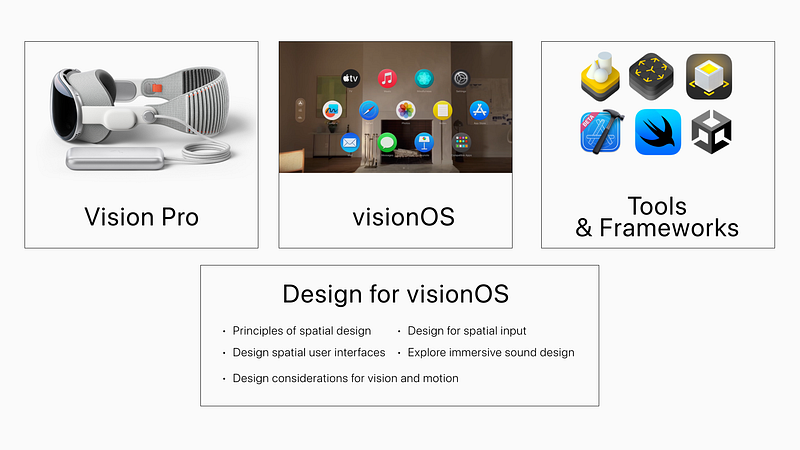
Vision Pro
Apple Invents the Personal Computer. Again. This was from the document released in 1983. And Apple Reinvents the Phone with iPhone in 2007. Now after 16 years Introducing, Apple Vision Pro: Apple’s first spatial computer.
In the same way that Mac introduced us to personal computing and iPhone introduced us to mobile computing, Apple Vision Pro will introduce us to spatial computing. — Tim Cook

Vision Pro is powered by a dual-chip (M2+R1) featuring 223 million pixels across two displays — more than a 4K TV for each eye. It can stream new images to the displays within 12 milliseconds, eight times faster than the blink of an eye. It lets you interact with the three-dimensional interface with the help of eye, hands, and voice.

Vision Pro
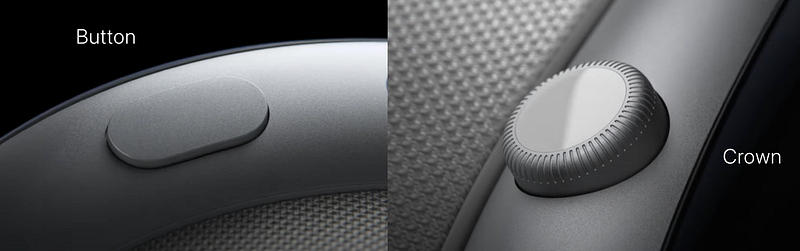
Vision Pro has a wide array of sensors and cameras (12 cameras, five sensors, and six microphones). The whole experience or feature set discussed during the launch relies on it. It also has two physical input systems a button to capture spatial photos and video and a Digital Crown to summon the Home View and to control immersion levels of Environments by rotating.
The Vision Pro comprises the main computing unit, a customizable LightSeal, Head Band, an External Battery pack, and optional optical inserts.
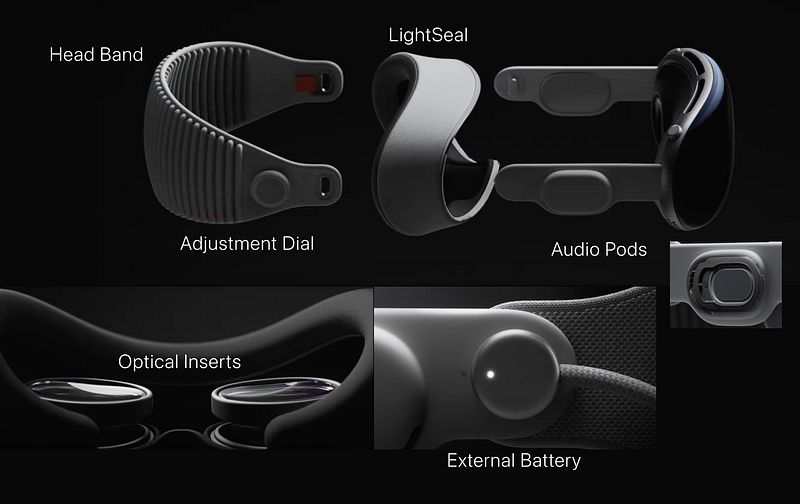
The main computing unit features Audio Pods with audio ray tracing to provide a spatial audio experience.
visionOS — Spatial Operating System
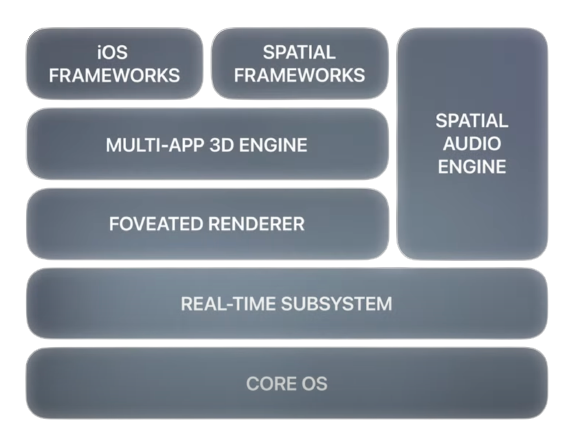
- Home View — App Launcher
- Eyesight — a 3D display that makes the device look transparent.
- Environment — Digital space that expands your reality
- Gesture System — Select: Tap your fingers together, Scroll: Flick
Mac with the mouse.
iPod with the Click Wheel.
iPhone with Multi-Touch.
With Vision Pro, we set the ambitious goal to design an incredibly intuitive input model for spatial computing– one that can be used without controllers or additional hardware. Apple Vision Pro relies solely on your eyes, hands, and voice. It’s just you and your content. It’s remarkable, and it feels like magic.
- Voice Input and Virtual Keyboard for text input
- Siri
- Digital Persona — to enable speaker video on calls without a need for external cameras and to remove headset for more immersive conversations.
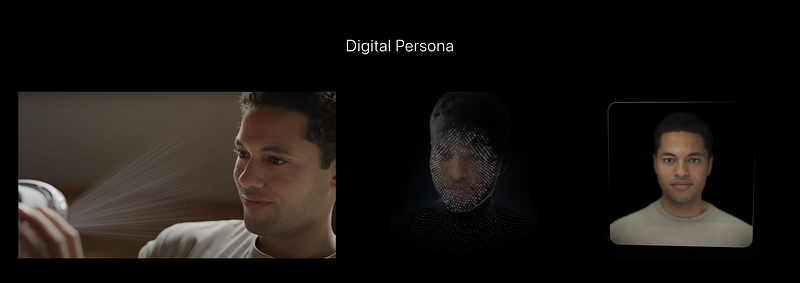
- Optic ID — Iris-based authentication system
- Privacy and Security
The Vision Pro is built with a privacy-first mindset, and all the data that are too personal, like eye tracking, is encrypted and never leaves the device. Eye input is isolated to a separate background process, so apps and websites can’t see where you are looking. Only tap is communicated. The camera data is processed at the system level, so individual apps can’t see the user's surroundings.
All the components in the visionOS have a sense of physicality and dimension, responding dynamically to light and casting shadows to help us understand scale and distance.
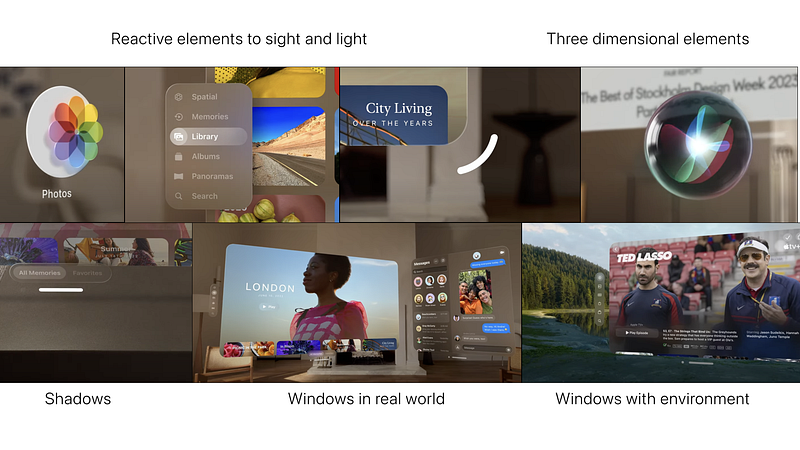
When Steve Jobs Introduced iPhone, iPod + Phone + Internet Communicator, and now with Apple Vision Pro — State-of-the-art TV + Surround sound system + Powerful computer with multiple high-definition displays, + High-end camera.
Reference Links:
Designing Spatial UI: Part 1Understanding Spatial Sizingsiddarth.design
What is an Extended reality?The Future of Human-Computer Interactionsiddarth.design